


The Hidden Narratives of Tarot: A Blueprint for Life and Storytelling

In the realm of creation, everything begins with a choice and an action. Characters are defined by their deeds and the paths they dare to tread. In the mystical deck of Tarot, this journey begins with The Fool (The Wanderer, the Innocent).
The Fool represents youth, hope, and an open heart—yet he lacks the bitter taste of experience. He gazes at the horizon with idealistic eyes, unaware that he is about to step off a cliff. Every great story starts with a “Fool.” Whether it’s a naive protagonist in a thriller or a writer staring at a blank page with childlike optimism, we all begin as The Fool, intoxicated by the thrill of a new beginning, oblivious to the “plot twists” waiting to drop us into the abyss.
The Architecture of the Soul: From Innocence to Wisdom
Architecture teaches us that “form follows function.” In fiction and in life, the same principle applies. We are all storytellers, even when we aren’t at our keyboards. We weave narratives out of daily glances and silent gestures. Nearly six hundred years ago, these universal human experiences seeped into the Tarot.
If you lay out the 22 cards of the Major Arcana in a circle, you aren’t just looking at symbols; you are looking at the universal blueprint of the human soul. The sequence from The Fool to The World tells the story of how we evolve from the purity of youth to the profound wisdom of adulthood.
Drafting the Journey: Tarot as a Creative Guide
In my own creative process, I have used the Tarot as a structural skeleton. By aligning plot points with the archetypes of the Major Arcana, a story gains a cosmic resonance.
-
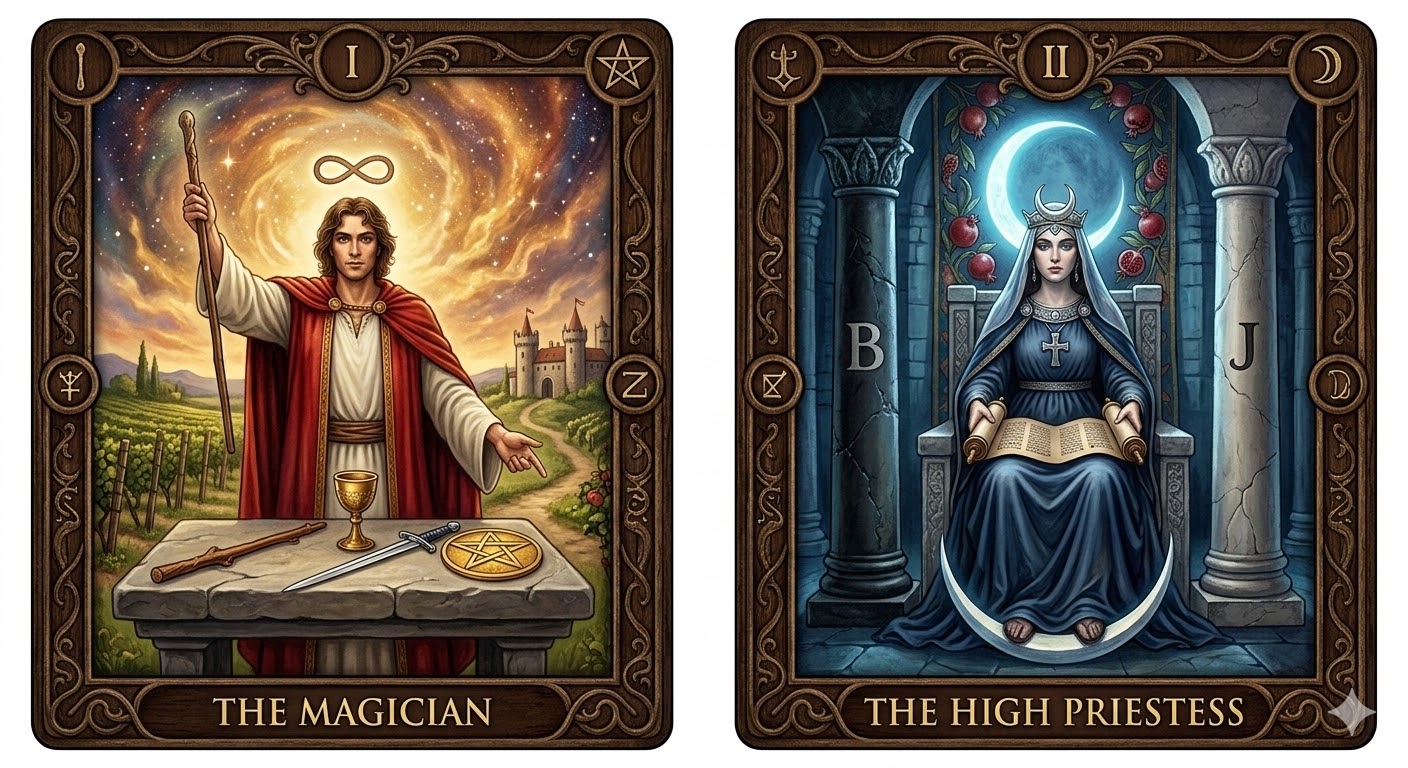
The Magician: The ultimate showman. He provides the clues, but he also creates the illusions. In your story, he represents the “red herrings” and the clever twists.
-
The High Priestess: The guardian of secrets. she guides you through the potential of the subconscious, showing that within the boundaries of imagination, nothing is impossible.
-
The Emperor & Empress (Yin and Yang): These cards demand that your characters be whole and believable. A reader will not follow a half-formed personality.
-
The Hierophant: He represents the “Big Idea.” Beyond a clever plot, what is the soul of your story? What is the truth you want the reader to reconstruct after the final page?
Conflict, Choice, and the Turning Point
The moment of decision arrives. The Lovers represent the crossroads where the heart often defies the mind. This choice leads directly to The Chariot, symbolizing the struggle to control opposing forces.
As a writer or a seeker, when you reach the midway point, you encounter Strength. You feel the chaos, yet you must open the lion’s mouth and take control. This is where you decide the ultimate “why” of your journey.
The Descent and Resurrection
The second half of the journey is demanding. The Wheel of Fortune reminds us that luck is a cycle. Justice demands accountability, and The Hanged Man asks for sacrifice to gain a new perspective. Then, Death enters the stage. It is rarely a literal end, but always a profound transformation—the clearing of the old to make way for the final reckoning.
Through the balance of Temperance and the raw shackles of The Devil, we move toward the inevitable: The Tower. The Tower represents the collapse of everything man-made and false. It is the ultimate crisis.
Yet, amidst the ruins, The Star shines—a glimmer of hope. In the deceptive light of The Moon, one might lose their way, but eventually, The Sun rises to reveal who remained true to their path.
The Final Judgment and The World
The final judgment belongs to you. Who wins? Who loses? Is the circle complete? The World signifies the dance of wisdom—the realization that every ending is merely a new beginning. We finish one journey only to return to the start, once again as the innocent Fool, ready for the next cycle of life.