

The Eternal Odyssey of Tarot: From Medieval Courts to the Mirror of the Soul


Every profound transformation begins with a single, courageous step. The Fool represents the soul’s pure and fearless entry into the physical world, walking toward the unknown with divine trust. His curiosity is his greatest shield.” #ruhisigi #soullight
Tarot is not merely a deck of 78 cards used for fortune-telling; it is a sophisticated symbolic language that has evolved over six centuries. To understand its history is to trace the intersection of Eastern trade, Renaissance art, occult philosophy, and modern psychology. It is a living map of the human experience, evolving from a simple parlor game into a profound tool for spiritual and psychological insight.
1. The Eastern Genesis: The Mamluk Migration
The true history of Tarot does not emerge from the mists of Ancient Egypt, as 18th-century mystics once claimed, but from the courts of the Mamluk Sultanate in Egypt. In the mid-14th century, “Mamluk” cards entered Europe through the bustling trade ports of Italy and Spain.
These early decks consisted of 52 cards divided into four suits: Scimitars (Swords), Cups, Coins, and Polo Sticks (Wands). Because Islamic law generally discouraged the depiction of human figures, these cards were adorned with complex calligraphic patterns and geometric designs. As they settled into European soil, artisans adapted these symbols to fit Western feudal society, introducing the “Court Cards” (King, Queen, Knight, Page) and setting the stage for the structural foundation of the Tarot we use today.
2. The Renaissance Revolution and the “Trionfi”
The definitive “Tarot moment” occurred in Northern Italy—Milan, Ferrara, and Bologna—between 1440 and 1450. Aristocratic families began adding 22 “trump” cards to the existing 56-card deck. These were called “Trionfi”(Triumphs), inspired by the theatrical parades and allegorical triumphs common in Renaissance festivities.
The Visconti-Sforza deck, commissioned by the Duke of Milan, remains the most iconic artifact of this era. Hand-painted with gold leaf, these cards were luxury items for the elite. To a person living in the 15th century, cards like The Empress, The Pope (Hierophant), and The Wheel of Fortune were not mystical secrets; they were familiar cultural archetypes representing the social hierarchy, moral virtues, and the inescapable power of fate. At this stage, Tarot (then known as Tarocchini) was strictly a high-stakes strategy game.
3. The Great Transformation: From Game to Occult Key
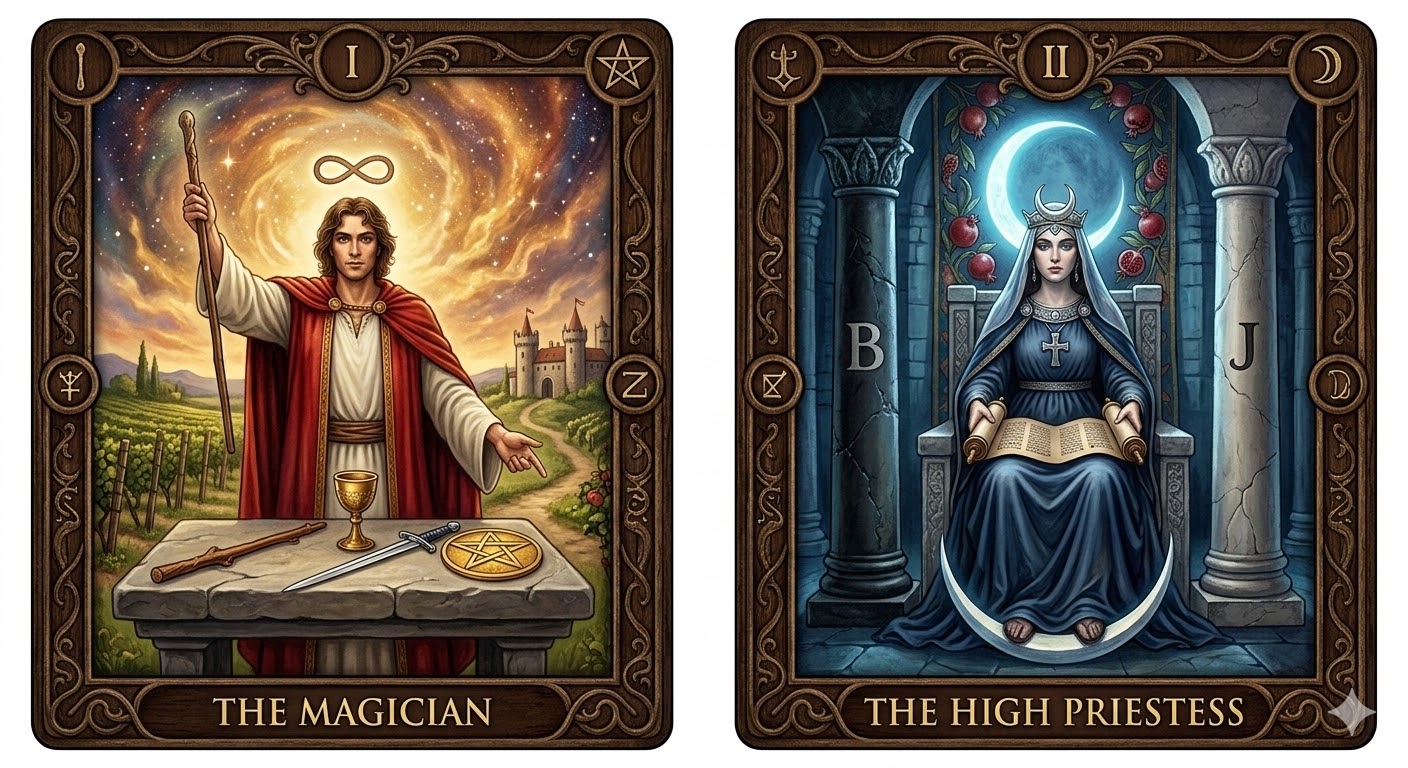
“The power of the universe flows through two channels: The Magician is the active will that shapes the external world, while the High Priestess sits between the pillars of mystery, guarding the silent depths of inner wisdom. One acts, the other knows.” #ruhisigi #soullight
For over 300 years, Tarot remained a game. The shift toward the “occult” happened during the French Enlightenment in 1781. Antoine Court de Gébelin, a Protestant clergyman and Freemason, published an essay declaring that Tarot was actually the lost “Book of Thoth,” preserved by Ancient Egyptian priests to hide sacred wisdom from the uninitiated.
Though his historical claims were purely speculative, they forever changed the trajectory of the cards. Shortly after, Etteilla (Jean-Baptiste Alliette) published the first comprehensive manual for Tarot divination, assigning astrological correspondences and elemental associations to each card. In the mid-19th century, the French occultist Eliphas Léviprovided the ultimate bridge by linking the 22 Major Arcana cards to the 22 letters of the Hebrew alphabet and the 22 paths on the Kabbalistic Tree of Life. This synthesis elevated Tarot from a common curiosity to the central pillar of Western Esotericism.
4. The Golden Dawn and the “Aptal’s Journey” (The Fool’s Journey)
Modern Tarot was redefined in 1909 by Arthur Edward Waite and the artist Pamela Colman Smith, both members of the Hermetic Order of the Golden Dawn. Their creation, the Rider-Waite-Smith deck, revolutionized the system by illustrating the Minor Arcana with narrative scenes.
This era introduced the concept of the “Fool’s Journey.” In this perspective, the 22 Major Arcana are seen as a chronological narrative of the human soul’s evolution.
-
The Beginning: The Fool (0) represents the soul’s leap into physical existence, pure and unformed.
-
The Teachers: Meeting the Magician and the High Priestess represents the balance of conscious action and intuitive wisdom.
-
The Crisis: Cards like The Tower and Death symbolize the necessary destruction of the ego and the shedding of old skins.
-
The Completion: The journey ends with The World (21), representing total integration, enlightenment, and the successful completion of a karmic cycle.
5. Jungian Archetypes and the Mirror of the Soul
In the 20th century, Tarot entered the realm of science through the work of Carl Gustav Jung. Jung identified that the figures in the Tarot are universal Archetypes—patterns of energy that exist in the “Collective Unconscious” of all humanity.
The Hermit is the archetype of the Inner Seeker; the Empress is the Great Mother. This psychological approach shifted the focus of Tarot from “predicting the future” to “understanding the present.” Today, Tarot is used by therapists, coaches, and spiritual seekers as a mirror to the subconscious. When a card is drawn, it doesn’t “predict” an event; it resonates with a part of the psyche that is ready to be acknowledged, facilitating a process Jung called Synchronicity.
6. Tarot in the 21st Century: The Digital Renaissance
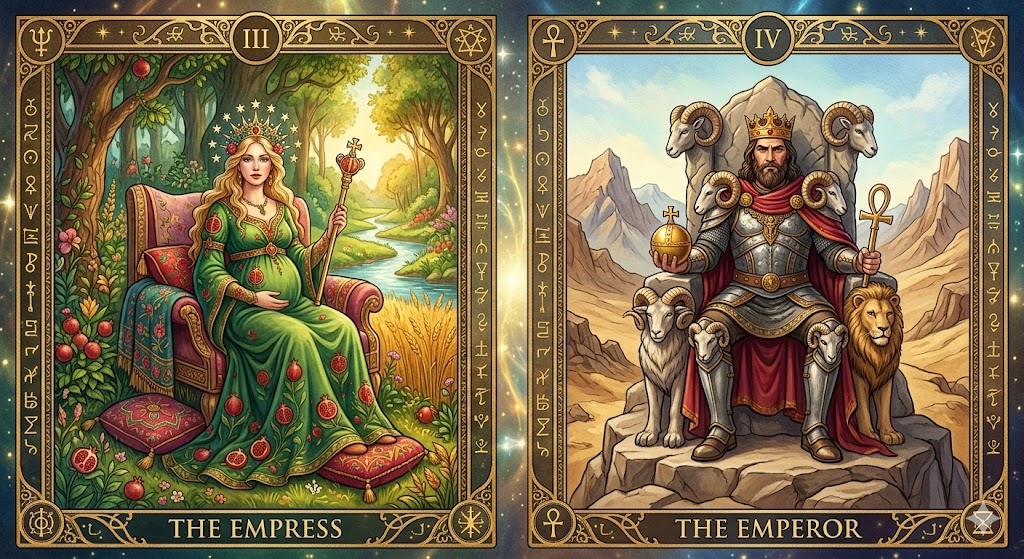
“Life flourishes between abundance and discipline. While The Empress nurtures all creation with love and fertility in her lush garden, The Emperor provides the structure, laws, and protection necessary for that life to endure. The sacred union of divine feminine and masculine authority.” #ruhisigi #soullight
Today, Tarot is experiencing a massive revival through digital platforms and high-fidelity art. From the minimalist decks of modern designers to AI-assisted interpretations, the 78 keys continue to unlock the mysteries of the human heart. In an age of digital noise, the ancient symbols of the Tarot provide a much-needed sanctuary for silence and self-reflection.
Whether we view it as a historical curiosity, a psychological tool, or a spiritual guide, Tarot remains a testament to the human desire to find order in chaos. Its journey from the Mamluk courts to the digital screens of today is a 600-year-old story of wisdom that refuses to be forgotten.
Conclusion The evolution of Tarot is a mirror to our own evolution. As we continue to seek balance (balans) between our material lives and our spiritual essences, these 78 cards serve as a compass, guiding us through the labyrinth of the soul.
#ruhisigi #soullight