


Beyond the Wine-Dark Sea: The Esoteric Codes of Homer’s Odyssey

Beyond the Wine-Dark Sea: The Esoteric Codes of Homer’s Odyssey
We are all familiar with the epic tale of Odysseus. After the fall of Troy, the King of Ithaca embarks on a ten-year journey to return to his wife, Penelope, and his kingdom. He faces terrifying monsters, seductive goddesses, and the wrath of the gods. On the surface, it is a masterclass in storytelling, the archetype of the “Hero’s Journey.”
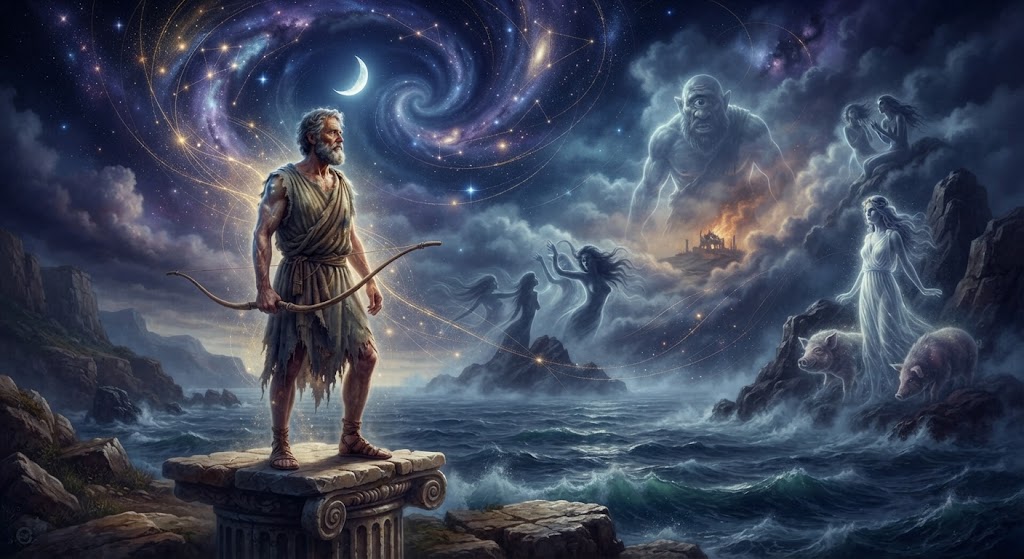
But what if I told you that the Odyssey is not merely an adventure, but an ancient manual for the soul? What if the Cyclops, Circe, the Sirens, and even the suitors are not just characters, but allegories for the internal states of consciousness that a human being must conquer to achieve true spiritual awakening?
Welcome to the world of mythological esotericism. In this analysis, we crack the esoteric codes of the Odyssey to reveal the hidden map of the soul’s evolution.
1. The Descent: The Trojan War as the Egos Battle
Before the journey begins, there is the war. In esoteric philosophy, the fall of Troy represents the soul becoming entangled in the material, sensory world (the “mortal realm”). The war itself symbolizes the constant conflict within the human psyche between the higher spiritual self (the Greeks/Achaeans) and the lower, base desires (the Trojans).
Odysseus’s journey home, therefore, is not just a geographical return; it is a metaphysical ascent back to the Divine Source (symbolized by Ithaca). Ithaca represents the Higher Self, the state of enlightenment and inner peace.
2. The Lotus Eaters: The Danger of Spiritual Forgetfulness
One of Odysseus’s first stops is the land of the Lotus Eaters. Those who eat the lotus forget their homeland, their purpose, and their mission. They desire only to remain in a state of blissful, stagnant stupor.
The Esoteric Code: This represents the trap of comfort, addiction, and spiritual bypassing. Many people on a “spiritual path” get lost in the “lotus” of feeling good, using meditation or philosophy merely to escape the realities of life rather than to do the hard work of transformation. The lotus is the sedative of the ego, preventing evolution.
3. Polyphemus the Cyclops: Conquering the Ego and Intellect
The encounter with the Cyclops, Polyphemus, is crucial. Polyphemus is a giant with one eye. He represents raw, unchecked instinct, brute force, and the single-mindedness of the unawakened intellect. He sees only the physical world and denies the spiritual.
Odysseus defeats the Cyclops by blinding his single eye.The Esoteric Code: This symbolizes overcoming the tyranny of the ego and the rational mind. The “single eye” is the limited vision of the physical senses. To awaken, one must “blind” this ego-centric view and open the “third eye”—the eye of inner vision and intuition. Furthermore, Odysseus cleverly calls himself “Nobody” (Outis). This is the ultimate esoteric lesson: to defeat the ego, one must dissolve the sense of a separate, grandiose “I.”
4. Circe and the Swine: Transmuting Base Instincts
On the island of Aeaea, the goddess-witch Circe turns Odysseus’s men into swine. They lose their human form and give in completely to animalistic gluttony and instinct. Odysseus, protected by the herb Moly (a gift from Hermes/Divine Wisdom), resists her magic and forces her to restore his men.
The Esoteric Code: This is the process of alchemy and transmutation. The swine represent the uncontrolled lower chakras and base instincts (greed, lust, fear). Circe is the testing ground of the material world. To pass this test, the seeker must possess Moly—divine knowledge, self-control, and awareness. Instead of being consumed by base desires, the initiate masters them, using that vital energy for spiritual elevation.
5. The Underworld (Nekuia): Confronting the Shadow Self
Following Circe’s guidance, Odysseus must travel to the realm of Hades to consult the blind prophet Tiresias. He must face the dead, including his own mother and fallen comrades.
The Esoteric Code: This is the mandatory “Dark Night of the Soul.” To ascend, one must descend. This represents Carl Jung’s concept of “Shadow Work.” The initiate must enter the subconscious, face their deepest fears, traumas, and repressed aspects of the self. Tiresias, the blind prophet, symbolizes that true wisdom comes from turning away from the outer world (blindness) and listening to the inner voice of intuition and ancestral knowledge.
6. The Sirens: Resisting the Allure of Temptation
The Sirens are beautiful maidens whose song lures sailors to their doom on the rocks. Odysseus, longing to hear their song but fearing destruction, has himself lashed to the mast and commands his crew to plug their ears with wax.
The Esoteric Code: The Sirens represent the seductive power of the psychic, emotional, and astral realms. These can be beautiful and alluring, but if the seeker becomes attached to these experiences (the “song”), they will be destroyed by the rocks of illusion. Being “lashed to the mast” symbolizes unwavering willpower, discipline, and commitment to the spiritual goal, allowing the seeker to witness the temptation without being consumed by it.
7. Ithaca: The Final Return to the Self
After twenty years, Odysseus returns to Ithaca. But he does not simply walk into his palace. He arrives as a beggar, unrecognized even by his own household. He must first reclaim his home from the suitors who are devouring his wealth and harassing his wife.
The Esoteric Code: The beggar represents the true spiritual initiate: humble, detached from worldly status, and stripped of the false ego. The suitors symbolize the final residues of the ego—greed, arrogance, and attachment to the material world—that have occupied the “palace” of the soul.
Odysseus’s final act is to string his bow and shoot an arrow through twelve axe-heads. The bow requires immense strength and spiritual alignment. The twelve axe-heads symbolize the twelve signs of the Zodiac or the twelve stages of initiation. The arrow is the focused, awakened consciousness that pierces through all illusions, uniting the human will with the Divine Will.
Conclusion: The Journey is the Destination
The Odyssey is an eternal story because it is our story. We are all Odysseus, lost on the wine-dark sea of life, yearning for our true home, Ithaca—the state of Inner Divinity.
The monsters we face are not external; they are our own fears, doubts, addictions, and ego-attachments. The message of the Odyssey is clear: the path to the Self requires courage to face the darkness, wisdom to transmute base instincts, and the discipline to remain lashed to the mast of your purpose until you finally reach the shores of your own awakened soul.
Ruh Işığı Yorumu (Soul Light Commentary)
Every myth carries a code, and every legend is a whisper of the Truth. Homer’s Odyssey is not just an ancient tale; it is a blueprint for the evolution of human consciousness. When we read it with the eyes of the soul, we realize that the greatest voyage is not across the sea, but within. Let this epic inspire you to face your own Cyclops, resist your Sirens, and ultimately, return to the sacred kingdom of your Higher Self.
If this esoteric interpretation resonated with your journey, share this light with others. Follow my page for more deep dives into the intersection of mythology, psychology, and spirituality.
Subscribe via email to stay updated on new posts on ruhisigi.com!
Thank you for reading. Take what resonates with your soul, and leave the rest with love.
#Mythology #Odyssey #Esotericism #SpiritualAwakening #JungianPsychology #ShadowWork #ruhisigi