


THE SUN AND FIXED STARS

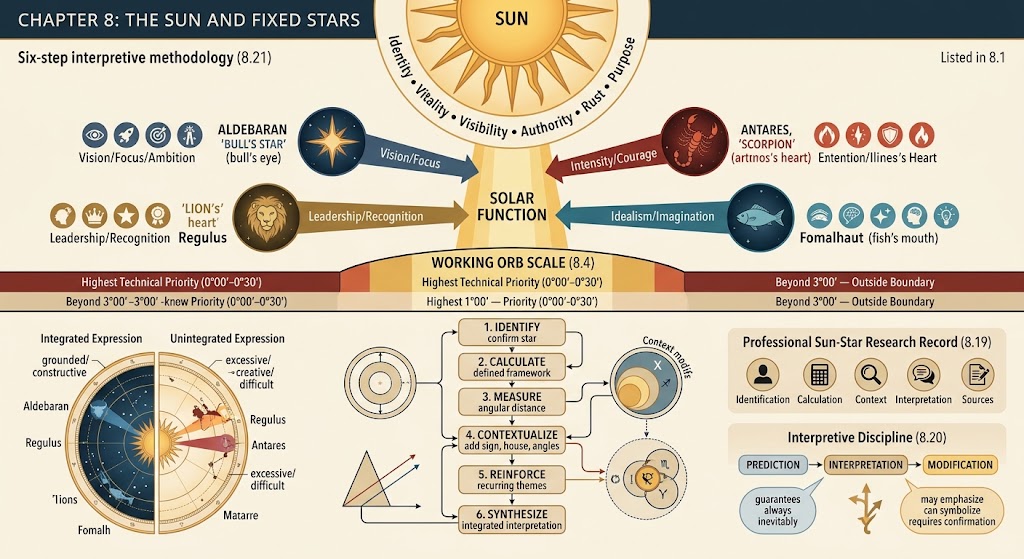
CHAPTER 8
THE SUN AND FIXED STARS
Identity • Vitality • Visibility • Authority • Purpose
The Sun is one of the central functions of a natal chart, especially when considering THE SUN AND FIXED STARS.
In astrological interpretation, it is associated with identity, vitality, conscious self-expression, creativity, purpose, visibility, confidence, and the development of an authentic sense of self.
When a fixed star forms a close conjunction with the Sun, the star does not replace these solar meanings.
Instead, it adds a distinct symbolic field to them.
This chapter therefore works from a simple principle:
The Sun provides the function; the fixed star modifies the symbolic quality of that function in THE SUN AND FIXED STARS.
The interpretation then depends on the sign, house, exactness of contact, and wider chart context.
8.1 Chapter Roadmap
This chapter focuses on the practical interpretation of Sun–fixed-star contacts.
It examines:
- The Solar Function
- Sun–Star Contacts
- Orb and Contact Exactness
- Zodiacal and House Context
- Solar Visibility and Authority
- Angular Contacts
- Symbolic Reinforcement
- Integrated and Unintegrated Expression
- Worked Examples
- Multiple Stars Contacting the Sun
- Natal and Temporary Contacts
- Research Documentation
- Interpretive Discipline
The purpose is not to create a dictionary of Sun–star combinations.
It is to establish a repeatable method that can be applied to different stars.
8.2 The Solar Function
Before interpreting a fixed star, the Sun itself must be understood.
Within the astrological framework used in this book, the Sun represents:
- conscious identity,
- vitality,
- self-expression,
- creativity,
- purpose,
- confidence,
- visibility,
- personal direction,
- leadership,
- and the development of an authentic sense of self.
The Sun should therefore not be reduced to the word “ego.”
Its symbolism is broader.
It concerns the process through which a person develops a coherent sense of identity and expresses that identity through life.
This is the function that the fixed star enters.
8.3 How a Fixed Star Modifies the Sun
The working formula is:
Sun + Fixed Star = Solar Function Colored by the Star’s Symbolic Field
For example:
Sun + Aldebaran https://ruhisigi.com/ruhisi-astrology-spiritual-guidance-the-four-royal-stars/
Aldebaran introduces themes traditionally and symbolically associated with:
Vision • Focus • Ambition • Integrity
The combination may therefore emphasize purposeful self-expression, ambition, leadership, or the relationship between achievement and principle.
Sun + Regulus
Regulus introduces:
Authority • Leadership • Recognition • Responsibility
The combination may emphasize personal authority, visibility, leadership, and the responsible use of recognition.
Sun + Antares
Antares introduces:
Intensity • Courage • Confrontation • Transformation
The combination may emphasize strong convictions, intense self-expression, courageous confrontation, or transformative experiences.
Sun + Fomalhaut
Fomalhaut introduces:
Vision • Idealism • Imagination • Inspiration
The combination may emphasize creative vision, ideals, imagination, and the pursuit of an inspiring purpose.
These examples illustrate the method.
They are not fixed predictions.
The same star may operate differently according to the Sun’s sign, house, condition, and wider chart pattern.
8.4 Contact Type and Orb
For the fixed-star work developed in this book, conjunctions receive primary attention.
This is consistent with the way fixed stars are commonly handled in traditional and modern fixed-star practice, where very close conjunctions are generally emphasized.
There is no single universally accepted orb standard for all fixed stars.
Therefore, this book adopts an explicit working methodology rather than presenting one orb as universally correct.
Working Orb Scale
0°00′–0°30′ — Extremely Close
Highest technical priority.
0°31′–1°00′ — Very Close
Strong primary contact.
1°01′–2°00′ — Close
Usable primary contact when supported by context.
2°01′–3°00′ — Wide / Secondary
Considered only when the chart provides additional support.
Beyond 3°00′ — Outside the Primary Working Boundary
Normally excluded from the principal analysis.
This scale belongs specifically to the methodology of this book.
It should not be presented as a universal rule of fixed-star astrology.
The important distinction is:
A 3° boundary is not the same thing as a 3° preferred orb.
A contact at 0°05′ receives considerably more technical attention than one at 2°45′.
8.5 Calculating Contact Exactness
For a conjunction, the basic calculation is the angular difference between the Sun’s zodiacal longitude and the star’s zodiacal longitude.
For example:
Sun: 15°20′ Taurus
Star: 15°25′ Taurus
Difference:
0°05′
Therefore:
Orb = 0°05′
Classification:
Extremely Close
Another example:
Sun: 15°20′ Taurus
Star: 17°00′ Taurus
Difference:
1°40′
Classification:
Close
A third example:
Sun: 15°20′ Taurus
Star: 18°00′ Taurus
Difference:
2°40′
Classification:
Wide / Secondary
The numerical distance establishes technical closeness.
It does not, by itself, establish interpretive importance.
8.6 Contact Exactness and Interpretive Weight
Three different questions must be kept separate:
1. How close is the contact?
This is contact exactness.
2. What is the star?
This establishes its astronomical identity and traditional symbolic field.
3. How does the contact function in the chart?
This requires sign, house, angles, planetary condition, and wider chart context.
Therefore:
Exactness establishes technical priority; context establishes interpretive relevance.
A 0°05′ contact deserves closer examination than a 2°50′ contact.
But even an extremely close contact should not be interpreted in isolation.
8.7 Zodiacal Framework and Verification
Before interpreting a Sun–star contact, the calculation must be reproducible.
The researcher should record:
- zodiacal framework,
- epoch,
- star longitude,
- Sun longitude,
- contact type,
- orb,
- astronomical source,
- and calculation method.
For example:
Star: Regulus
Astronomical designation: Alpha Leonis
Zodiac: Tropical
Star longitude: 29°55′ Leo
Sun: 29°50′ Leo
Contact: Conjunction
Orb: 0°05′
The exact star position must always be tied to the calculation framework and epoch.
This is particularly important because fixed-star longitudes change over time relative to the tropical zodiac through precession. Modern reference tables, for example, give Regulus at approximately 29°50′ Leo for 2000 and around 0°32′ Virgo for 2050.Thus, a degree written without a date or framework is incomplete technical information.
8.8 The Sun Through Sign and House
Once the star and contact have been verified, the sign and house determine how the solar function is expressed and where it becomes most relevant.
The sign describes style.
The house describes area of life.
For example:
Sun–Regulus in the 10th House
Possible emphasis:
- public identity,
- leadership,
- professional responsibility,
- visibility,
- achievement,
- authority.
The correct interpretation is not:
“This person will become famous.”
A more defensible formulation is:
The chart may place particular emphasis on developing a visible identity through leadership, responsibility, and purposeful contribution.
The same Sun–Regulus contact would operate differently in another house.
Sun–Regulus in the 5th House
The emphasis may shift toward:
- creative leadership,
- personal expression,
- performance,
- mentoring,
- entrepreneurship,
- creation.
Sun–Regulus in the 11th House
The emphasis may shift toward:
- group leadership,
- networks,
- collective projects,
- organizations,
- community contribution.
The star has not changed.
The Sun has not changed.
The context has changed.
That is why fixed-star interpretation cannot be reduced to keywords.
8.9 Solar Visibility and Authority
A Sun–star contact can bring questions of visibility into the interpretation.
However:
Visibility ≠ Fame
Solar visibility can mean:
- being recognized for one’s work,
- expressing oneself publicly,
- taking responsibility,
- developing confidence,
- becoming identifiable through a contribution,
- or assuming a leadership role.
Likewise:
Authority ≠ Political Power
Solar authority may describe:
- self-direction,
- decision-making,
- personal responsibility,
- creative authority,
- professional leadership,
- or confidence in one’s own judgment.
A fixed star may therefore emphasize a particular dimension of solar authority without predicting a specific social status.
8.10 Solar Vitality
The Sun is also traditionally associated with vitality.
In this book, solar vitality is treated symbolically rather than medically.
It may refer to:
- motivation,
- creative drive,
- enthusiasm,
- confidence,
- energetic participation,
- commitment,
- and engagement with life.
A Sun–star contact should not be used by itself to diagnose illness or predict medical events.
Astrological symbolism and medical assessment are separate domains.
8.11 Angular Sun–Star Contacts
A Sun–star contact can gain additional chart context when the Sun or the contacted star is closely connected with an angle.
The principal angles are:
- Ascendant,
- Midheaven,
- Descendant,
- IC.
For example:
Sun + Regulus + Midheaven
combines:
Solar identity
with:
Regulus symbolism
and:
public or vocational context
This may make questions of visibility, leadership, authority, and responsibility more prominent within the chart.
It still does not establish guaranteed fame.
The angle adds context.
It does not turn symbolism into certainty.
8.12 Symbolic Reinforcement
A Sun–star contact becomes more significant when similar themes appear independently elsewhere in the chart.
For example:
Sun conjunct Regulus
combined with strong emphasis on:
- the Midheaven,
- the 10th house,
- leadership,
- authority,
- public contribution,
- or other closely connected indicators
may create a coherent pattern.
The fixed star is then not standing alone.
It participates in a repeated symbolic theme.
This is Symbolic Reinforcement.
The principle can be expressed simply:
Repeated symbolism deserves more attention than isolated symbolism.
8.13 Integrated and Unintegrated Expression
Fixed-star symbolism should not be divided into rigid categories of “good” and “bad.”
A more useful distinction is:
Integrated Expression ↔ Unintegrated Expression
| Star | Integrated Expression | Unintegrated Expression |
| Aldebaran | Purposeful ambition with integrity | Ambition without restraint |
| Regulus | Responsible authority | Status dependence or excessive pride |
| Antares | Courage and conscious transformation | Conflict-driven intensity |
| Fomalhaut | Inspired vision grounded in reality | Idealization detached from reality |
These are interpretive possibilities, not predictions.
They also do not mean that every Sun contact with one of these stars must express both sides.
The chart determines the context.
8.14 Worked Example I — Sun Conjunct Regulus
Consider a fictional chart:
Sun: 29°50′ Leo
Regulus: 29°55′ Leo
Contact: Conjunction
Orb: 0°05′
House: 10th
Zodiac: Tropical
The technical contact is extremely close.
The symbolic components are:
Regulus
Authority • Leadership • Recognition • Responsibility
Sun
Identity • Purpose • Visibility • Self-expression
Leo
Creative expression • Confidence • Visibility
10th House
Vocation • Public role • Achievement • Responsibility
The interpretation can therefore be formulated as:
This configuration may place strong symbolic emphasis on developing a visible identity through leadership, responsibility, and purposeful contribution. Recognition may become relevant to the individual’s public or vocational identity, while the more integrated expression depends upon exercising authority without becoming overly dependent on status.
This is more precise than:
“This person will become famous.”
The latter statement turns symbolism into prediction.
The first remains within the methodological limits of the chart.
8.15 Worked Example II — Sun Conjunct Antares
Consider another fictional chart:
Sun: 9°18′ Sagittarius
Antares: 9°20′ Sagittarius
Contact: Conjunction
Orb: 0°02′
House: 9th
Zodiac: Tropical
The contact is extremely close.
The symbolic components are:
Antares
Intensity • Courage • Confrontation • Transformation
Sun
Identity • Purpose • Vitality • Self-expression
Sagittarius
Meaning • Belief • Exploration • Knowledge
9th House
Higher learning • Philosophy • Publishing • Worldview
A disciplined interpretation could therefore be:
This configuration may connect personal identity and purpose with intense engagement in questions of meaning, knowledge, belief, and worldview. Its integrated expression may involve courageous examination of difficult ideas and transformative learning, while an unintegrated expression may become overly attached to ideological conflict.
Again, the star does not determine the outcome.
The interpretation emerges from the complete configuration.
8.16 What the Two Examples Demonstrate
The two examples have similarly close orbs:
Sun–Regulus: 0°05′
Sun–Antares: 0°02′
Both therefore receive high technical priority.
Yet their meanings differ because the symbolic fields differ.
The interpretation is constructed from:
Star → Sun → Sign → House → Exactness → Chart Context
This demonstrates an important principle:
Orb determines technical closeness; it does not determine symbolic meaning.
8.17 Multiple Fixed Stars Contacting the Sun
A Sun may form close contacts with several fixed stars.
When this happens, the correct response is not to create several independent predictions.
Instead:
Identify
Confirm every star’s astronomical identity.
Measure
Calculate the exact orb of each contact.
Compare
Determine which contacts are closest.
Group
Look for recurring symbolic themes.
Synthesize
Construct one coherent interpretation of the solar pattern.
For example, if several stars independently emphasize:
- leadership,
- visibility,
- responsibility,
- purpose,
then the repeated theme may be more significant than any individual keyword.
This prevents the interpretation from becoming a collection of unrelated star meanings.
8.18 Natal and Temporary Sun–Star Contacts
Sun–star contacts can be studied in different chart contexts, including:
- natal charts,
- Solar Returns,
- progressions,
- transits,
- mundane charts,
- and other timing techniques.
These should not be interpreted as though they were equivalent.
A natal Sun–star conjunction is a permanent component of the natal chart.
A transiting Sun–star conjunction is temporary.
A Solar Return contact belongs to the symbolism of that particular return year.
Therefore, every analysis should clearly identify the chart type.
This chapter establishes the principal method for:
Natal Sun–Fixed-Star Contacts
Timing techniques require additional rules and should not simply be transferred from natal interpretation.
8.19 Professional Sun–Star Research Record
For serious research, record each contact using a standardized structure.
Identification
- Fixed Star
- Astronomical Identifier
- Constellation
Calculation
- Zodiacal Framework
- Epoch
- Star Longitude
- Sun Longitude
- Contact Type
- Orb
- Calculation Source
Natal Context
- Sun Sign
- Sun House
- Angular Status
- Other Relevant Chart Factors
Interpretation
- Stellar Symbolic Field
- Solar Function
- Symbolic Reinforcement
- Modifying Factors
- Final Synthesis
Sources
- Astronomical reference
- Historical source
- Astrological source
- Calculation source
The purpose is simple:
Another researcher should be able to reconstruct how the interpretation was reached.
8.20 Interpretive Discipline
The strength of fixed-star interpretation depends partly on keeping the language proportional to the evidence.
Prefer:
- “may emphasize”
- “can symbolize”
- “may become more prominent when reinforced”
- “is traditionally associated with”
- “can be expressed through”
- “requires confirmation from the wider chart”
Avoid:
- “guarantees”
- “always produces”
- “will inevitably”
- “proves that”
- “determines destiny”
The fixed star is one component of the horoscope.
Even an extremely close conjunction should be interpreted within the larger structure of the chart.
8.21 The Sun–Star Method
The complete method can now be reduced to six steps:
1. IDENTIFY
Confirm the exact astronomical star.
2. CALCULATE
Establish the zodiacal position of the star and Sun using a defined framework and epoch.
3. MEASURE
Calculate the angular distance and classify the contact.
4. CONTEXTUALIZE
Add:
- Sun function,
- sign,
- house,
- angles,
- and relevant chart structure.
5. REINFORCE
Look for repeated themes elsewhere in the horoscope.
6. SYNTHESIZE
Produce one integrated interpretation rather than a list of isolated keywords.
The sequence is:
IDENTIFY → CALCULATE → MEASURE → CONTEXTUALIZE → REINFORCE → SYNTHESIZE
This becomes the practical working model for Sun–fixed-star analysis.
Conclusion
The Sun provides one of the clearest planetary channels through which fixed-star symbolism can be expressed.
Its principal functions include:
Identity • Vitality • Purpose • Visibility • Authority • Creativity • Conscious Self-Expression
A fixed star does not replace these functions.
It modifies their symbolic expression.
The working formula is:
Fixed Star + Sun + Sign + House + Contact Exactness + Chart Context = Interpretive Synthesis
The orb methodology used in this book is deliberately explicit:
0°00′–0°30′ — Extremely Close
0°31′–1°00′ — Very Close
1°01′–2°00′ — Close
2°01′–3°00′ — Wide / Secondary
Beyond 3°00′ — Outside the Primary Working Boundary
These are the working standards of this book, not a universal fixed-star rule.
The most important principle is therefore:
A close Sun–star contact deserves attention, but its meaning emerges from context rather than from the star alone.